What is omnichannel? How it works behind the scenes and where the chatbot fits
Omnichannel means serving customers across many channels as if it were one conversation. The definition fits in one sentence; the hard part is behind it. Each channel has its own reply rules, its own way of identifying the person and its own consent, and that is where most multichannel customer service stops being omnichannel. What it is, what changes in practice, and where the chatbot and AI fit in.
 CCX ProductProduct · Channel rules · Oct 21, 2026 · 10 min read
What you'll take away
- The difference between multichannel and omnichannel, and the test that tells them apart
- The rules that change from one channel to the next: reply window, identity and consent
- What a chatbot is, what changes with an AI agent, and when the conversation has to go to a person
What is omnichannel
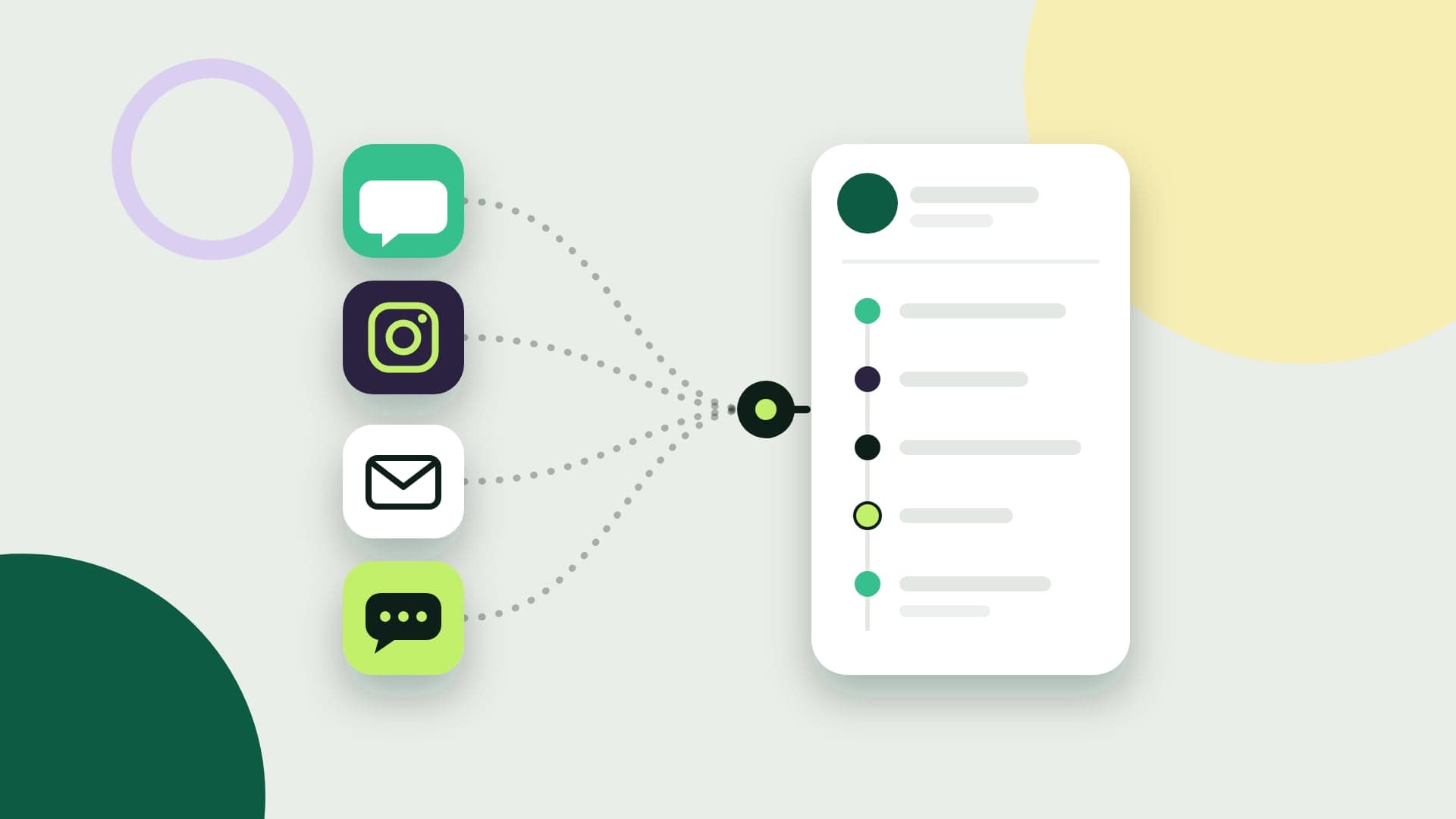
Omnichannel is a way of serving and selling in which the channels work as one system. The customer starts on Instagram, continues on WhatsApp, gets the confirmation by email and, if they call, whoever picks up knows all of it. The channel changes; the conversation, the history and the context go with it.
The word came from retail, where it describes the physical store, the website and the app working together: buy online and pick up in store, return in store what you bought on the website. In customer service, the idea is the same, applied to the conversation.
There are numbers that back the concept. A study published in Harvard Business Review in 2017 followed about 46,000 customers of a US retailer for 14 months. The 73% who used more than one channel spent 4% more per purchase in the store and 10% more online, and came back to buy more often. The authors warn that this is correlation, not causation.
In Brazil, the idea even shows up in regulation. The customer service decree (Decree 11.034/2022), which applies to the sectors regulated by the federal government, defines customer service as service delivered through several integrated channels. The word that matters there is integrated.
Multichannel is not omnichannel
Multichannel is being on many channels. Omnichannel is those channels knowing each other. A company with WhatsApp, Instagram, email and phone, each with its own team, its own tool and its own spreadsheet, is multichannel: the customer gets served on all of them, but on each one they start from scratch.
There is a simple test to find out which of the two your operation is. A customer asks about an order through Instagram Direct and, the next day, sends a message on WhatsApp. Does the person answering on WhatsApp see the Instagram conversation without asking for the order number again? If the answer is no, the operation is multichannel, no matter how many channels it has.
The test looks easy to pass, and it isn’t. To pass it, the system has to know that the person on Instagram and the person on WhatsApp are the same, keep both conversations in the same place and show both to whoever is answering. Each of those three things runs into a different rule on each channel.
Each channel has its own reply rules
On WhatsApp, a message from the customer opens a 24-hour window, and each new message restarts the clock. Inside it, the business can reply with anything; outside it, only with a template approved by Meta and paid per message. This is the rule that decides whether a reply that could go out this morning can still go out as free text in the afternoon.
On Instagram, the window is also 24 hours, but there are no templates. Once it closes, only a person can reply, in a separate 7-day window reserved for manual replies, and the business can’t start a conversation in Direct. The exception is comments: someone who commented can receive a single private message, within 7 days.
SMS and email have no window, and the rule that matters there is a different one. For SMS, it’s length: 160 characters in the standard alphabet, but a single character outside it, like the “ã” in the Portuguese “não”, usually drops the message to 70 characters per part. For email, it’s delivery: since 2024, Gmail and Yahoo require bulk senders to have an authenticated domain with SPF, DKIM and DMARC, one-click unsubscribe and a spam rate below 0.3%.
The consequence for customer service is concrete. A single queue with every channel has to show, in each conversation, what can still be done in it: reply freely, reply only with a template, reply only through a person, or not reply at all. Without that, the agent writes the perfect reply and then finds out it won’t send.
The hard problem: knowing it’s the same person
Each channel identifies the customer in its own way. On WhatsApp it’s the phone number, which Meta sends without the “+”. On Instagram, the person arrives with an identifier that only works for your account, with no phone number or email. On email, it’s the address. On SMS, it’s the phone number again, but sometimes stored differently in your records. Tying these ends together is the most underestimated job in omnichannel customer service.
In Brazil, the same mobile number shows up with and without the ninth digit, with and without the 55 country code, with and without the leading zero of the area code, and every country has its own version of this problem: country codes, leading zeros, spaces. Each spelling becomes a different contact if the system compares text to text. A duplicate profile splits the conversation: half the history in one, half in the other, and whoever is answering sees only one of the halves.
Our recommendation: merge automatically only what has proof, like the same normalized phone number or the same email address, and leave the rest for a person to confirm. A matching name is not proof, and merging two different people named Maria is worse than leaving one Maria in two profiles. The wrong profile shows one customer another customer’s conversation.
And the phone number is losing its place as a universal key, even on WhatsApp. With usernames, which Meta started rolling out in 2026, people can chat without showing their number, and webhooks now carry a per-portfolio identifier, the BSUID. The phone number disappears from the webhook for people who adopt a username, unless there was a conversation in the last 30 days, and Meta itself recommends storing more than one identifier per customer.
Consent is per channel
Data protection law sets the base. In Europe, the GDPR lists consent and legitimate interest among the lawful bases for processing personal data, and both are common grounds for marketing messages; in Brazil, the LGPD lists the same two in Article 7, items I and IX. Under the LGPD, consent can be withdrawn at any time through a free and easy procedure (Article 8, §5).
Platforms add their own rules on top of the law. WhatsApp’s policy only allows contacting people who gave their number and opted in, and requires honoring opt-out requests made inside or outside WhatsApp. Gmail requires one-click unsubscribe requests to be honored within 48 hours. Each channel has its own way of asking for permission and of taking it away.
In practice, this calls for consent recorded per channel, with date and source, not a single “accepts messages” field. Someone who opted out of marketing on WhatsApp may still want the delivery notice by email, and someone who unsubscribed from email hasn’t necessarily refused the SMS with a verification code.
The product rule that follows is simple to state and easy to forget: an opt-out applies from the moment it is made, on the channel where it was made, and for the purpose it refers to. An old message that gets reprocessed can’t become a new opt-out, and an opt-out on one channel can’t disappear because the customer wrote on another.
What a chatbot is, and what changed with AI
A chatbot is a program that talks to customers by message, with no person on the other side. For a long time, chatbot meant menu: type 1 for a copy of your invoice, 2 to talk to billing. That’s the rule-based bot, a decision tree in which each answer leads to a branch that was already written. It is predictable, cheap and frustrating when the question isn’t in the tree.
An AI agent is something else. It understands the question the way the customer writes it, looks for the answer in what the business gave it, such as the knowledge base, the catalog and the order status, and replies in plain sentences. The risk is different too: instead of not understanding, it can confidently give an answer that isn’t written anywhere. That’s why a good AI agent is one that knows when to stop.
On WhatsApp, Meta wrote a rule for this. Its messaging policy allows automation inside the customer service window as long as there is a quick, clear and direct path to a person: a human agent in the conversation, a phone number, an email address or another channel. Since January 15, 2026, the platform terms also ban general-purpose AI assistants when AI is the main function of the service. A business’s customer service AI, which answers questions about its own products and orders, is outside the ban, according to Meta.
In Brazil, the customer service decree points the same way for the sectors regulated by the federal government: for phone support, it requires human service to be available at least eight hours a day. A bot with no way out to a person isn’t just a bad experience; in some cases, it’s non-compliance.
In omnichannel customer service, the place for the bot and the AI agent is the front line, on every channel, with the same knowledge base. And the handoff to a person has to carry the whole conversation with it: a customer who explained the problem to the AI on Instagram shouldn’t have to explain it again to the human agent on WhatsApp.
How to tell if it’s working
The most honest sign of omnichannel customer service is that customers don’t repeat what they already said. You can measure this indirectly: how many conversations ask again for an order number, tax ID or email address that was already in another conversation with the same person. If that number is high, the channels don’t know each other.
The other signals are the same as in any customer service, only measured per customer and not per channel: time to first response, the time of the slowest responses, which usually tells you more than the average, and how many times the same issue comes back on different channels before it is resolved. A customer who sends the same question on Instagram and on WhatsApp because they got no answer on either is the picture of multichannel.
Finally, the bill. Each channel has its own cost: WhatsApp messages charged by category, SMS per message sent, email almost free, Instagram with no per-message fee. Bringing the channels into one place is also the chance to pick the channel by cost and by rule, not by the habits of whoever is answering.